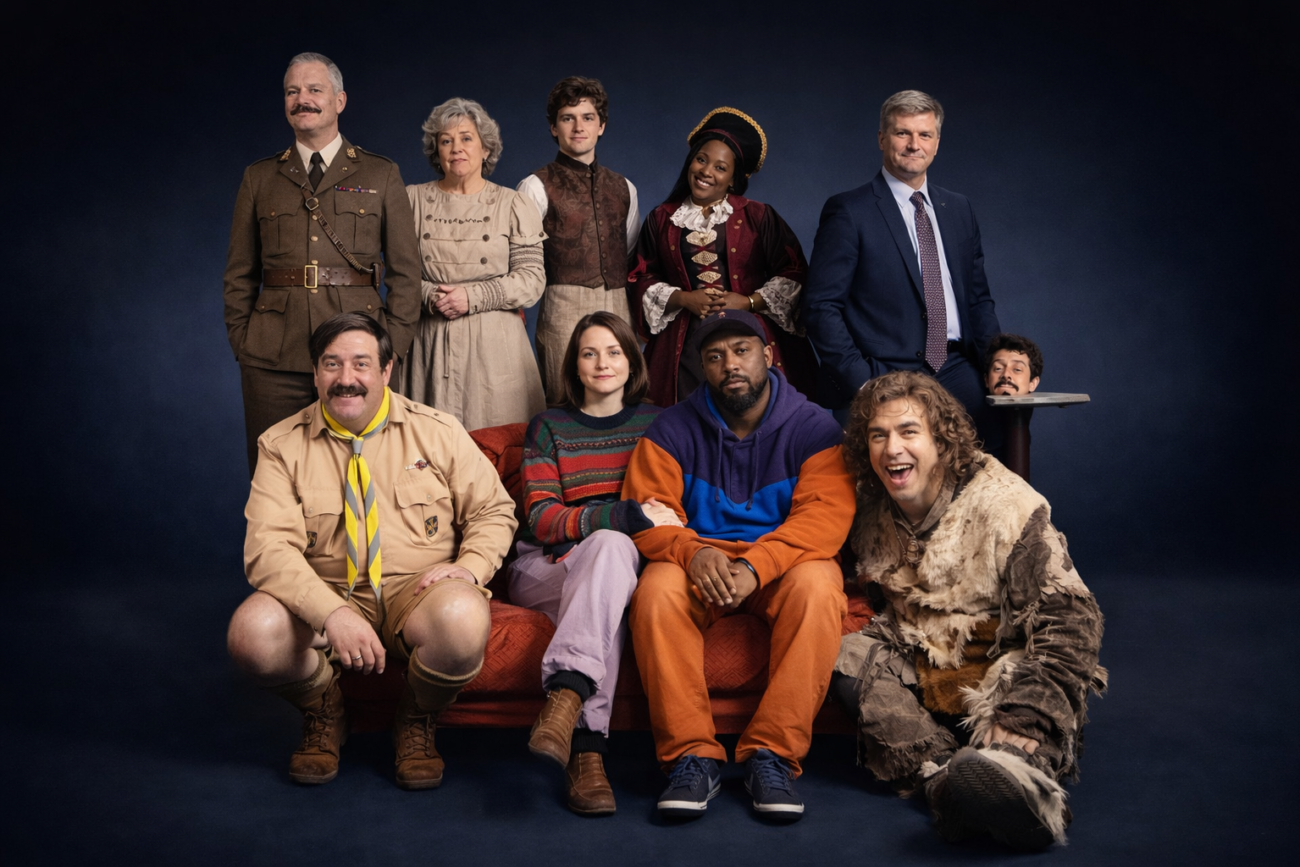
For most viewers, the name Kevin Corbishley appeared quietly, almost fleetingly, at the end of a television episode. There was no introduction, no explanation—just a dedication: “In loving memory of our friend Kevin Corbishley.” It was enough to stop people mid-scroll, to prompt a search, and to raise a simple question that turned out to have a more meaningful answer than expected. Who was he, and why did the people who worked with him feel compelled to honor him so publicly?
The answer is both straightforward and revealing. Kevin Corbishley was not a celebrity, nor a public figure in the conventional sense. He was a crew member—a rigger—whose work took place behind the camera on British television productions including Ghosts and Call the Midwife. Yet the warmth of the tributes that followed his death suggests a career defined not just by technical skill, but by presence, reliability, and the kind of quiet influence that shapes a working environment over years.
His story is not one of fame. It is a story about work, craft, and the invisible structure of television itself.
Early Life and Background
Publicly available information about Kevin Corbishley’s early life is limited, and that absence shapes how his biography can be told responsibly. There are no widely confirmed records detailing his birthplace, upbringing, or education, and no verified interviews or personal statements that outline his early ambitions. Unlike actors or directors, whose careers often unfold in public, crew members like Corbishley typically build their lives outside the spotlight.
What can be inferred, cautiously and within reason, is that he entered the British film and television industry through technical or practical training, as is common for rigging professionals. The role demands a combination of physical skill, safety awareness, and experience gained over time rather than through public-facing credentials. Careers in this field often begin through apprenticeships, on-set experience, or trade-based pathways, and they tend to develop gradually rather than through a single breakthrough moment.
That lack of early biographical detail is not unusual. It reflects the reality of an industry where many essential contributors remain largely undocumented unless something brings their names into wider circulation. In Corbishley’s case, that moment came not during his life, but after it.
Entering the Film and Television Industry
Kevin Corbishley’s professional footprint, as recorded in publicly accessible credits, places him within the technical backbone of British screen production. He is credited under both “Kevin Corbishley” and “Kev Corbishley,” a common variation in crew listings, particularly in departments where familiarity and shorthand often carry over into official documentation.
His work includes roles in the camera and electrical department, specifically as a rigger or standby rigger. This position is not decorative or peripheral. It involves constructing and maintaining the physical systems that support lighting, camera rigs, and sometimes set structures. It is work that demands precision, coordination, and an understanding of both engineering and production rhythm.
One of his earlier credited roles appears in the 2012 film Anna Karenina, where he is associated with the art department. That credit suggests a degree of versatility and indicates that his career may have spanned multiple technical disciplines before settling into rigging as a primary specialization. Such movement between departments is not uncommon in the early stages of crew careers, particularly in large-scale productions where different technical skills overlap.
Over time, Corbishley became part of the workforce that sustains long-running and high-demand productions. These are not short-term projects but ongoing collaborations that require consistency and trust.
Work on Call the Midwife
One of the clearest markers of Kevin Corbishley’s professional life is his involvement with Call the Midwife, the long-running BBC period drama set in postwar London. He is credited as a standby rigger in the camera and electrical department, with work spanning from around 2020 through 2022.
The role of a standby rigger is grounded in immediacy. It involves being present during filming to adjust, maintain, and support equipment and structures as scenes unfold. This is not work that happens only during setup. It continues throughout production, often requiring quick problem-solving under time pressure to ensure that filming proceeds safely and efficiently.
Call the Midwife is known for its detailed production design and careful recreation of historical environments. Maintaining that level of authenticity depends not just on visible elements like costumes and sets, but also on the unseen systems that allow those elements to be filmed convincingly. Lighting rigs, camera support structures, and temporary builds all fall within the domain of rigging work.
Corbishley’s involvement in such a production suggests a level of experience and reliability valued by the show’s production team. Long-running series tend to retain crew members who can adapt to the show’s demands and maintain consistency across episodes and seasons.
Contribution to Ghosts
For many viewers, Kevin Corbishley’s name became visible through the BBC comedy Ghosts. He is credited as a rigger on the series, with work appearing in the years leading up to the show’s fourth season.
Ghosts is a very different kind of production compared to Call the Midwife, but it shares a reliance on technical coordination. The show’s blend of physical comedy, ensemble acting, and controlled interior settings requires careful staging. Camera placements, lighting continuity, and structural support all contribute to the show’s distinctive look and pacing.
The first episode of season four, titled “Happy Holiday,” aired on September 23, 2022, and included a dedication to Corbishley. The message described him as “our friend,” a phrase that carries weight in an industry where professional relationships often become long-term collaborations.
What’s striking is not just that the show acknowledged him, but how it did so. The tribute was not framed in formal or distant language. It was personal, suggesting that his presence on set extended beyond technical competence into the social fabric of the production.
The Nature of Rigging Work in Television
To understand Kevin Corbishley’s career, it helps to understand what rigging actually involves. In the context of film and television, riggers are responsible for building and maintaining the structures that support equipment such as lights, cameras, and sometimes scenery.
This work often includes assembling scaffolding, securing heavy equipment, and ensuring that everything remains stable and safe throughout filming. It requires coordination with multiple departments, including lighting, camera, and production design. Safety is a central concern, as improperly secured equipment can pose serious risks.
The work is also time-sensitive. Productions operate on tight schedules, and delays can be costly. Riggers must be able to set up, adjust, and dismantle equipment efficiently, often working long hours and adapting to changing requirements.
What’s surprising is how invisible this work is to audiences. When rigging is done well, it disappears into the final product. Viewers see the scene, not the infrastructure that made it possible. That invisibility is part of why tributes like the ones for Corbishley stand out so strongly when they appear.
The Tributes That Brought His Name Forward
Kevin Corbishley’s death prompted tributes from at least two major television productions: Ghosts and Call the Midwife. Both shows included on-screen dedications, a gesture that is reserved for individuals who had a meaningful connection to the production.
The timing of these tributes in 2022 suggests that his passing occurred around that period, though publicly available sources do not provide a consistently confirmed date or cause of death. Some records reference the years 1965–2021, while others indicate 1965–2022, reflecting a degree of inconsistency in secondary sources.
What remains consistent is the tone of the tributes. They were not generic acknowledgments. They were personal, direct, and placed in episodes that reached wide audiences. That choice ensured that his name would be seen not only by colleagues, but by viewers who might never have otherwise encountered it.
The response was immediate. Viewers searched for his name, discussed the tribute, and tried to piece together who he had been. In doing so, they briefly shifted attention toward the people who build television from behind the scenes.
Personal Life and Privacy
There is very little publicly confirmed information about Kevin Corbishley’s personal life. Details about his family, relationships, or private interests have not been widely documented in accessible sources. This is not unusual for crew members, whose professional identities are often separate from their personal lives in public records.
The absence of such details should be treated with care. It is easy to fill gaps with speculation, but responsible reporting requires acknowledging what is not known. In Corbishley’s case, his legacy is best understood through his work and the way he was remembered by those who worked with him.
The phrase “our friend” used in the Ghosts tribute offers a glimpse into how he was perceived by colleagues. It suggests that his impact extended beyond technical contributions, shaping the day-to-day experience of working on set.
Career Scope and Industry Standing
Kevin Corbishley’s credited work may appear modest in volume compared to high-profile figures, but it reflects a steady presence in respected productions. Shows like Call the Midwife and Ghosts are not entry-level projects. They are established series that rely on experienced crew members to maintain quality and consistency.
In the film industry, careers are often built on reputation rather than public visibility. A crew member who is reliable, skilled, and easy to work with is likely to be rehired across projects. That pattern can lead to long-term involvement in major productions without generating a large public profile.
Corbishley’s repeated involvement in such productions suggests that he was part of this trusted network. While there are no widely publicized awards or honors attached to his name, the tributes he received serve as a different kind of recognition—one that comes directly from colleagues rather than institutions.
Financial and Net Worth Information
There are no publicly verified figures regarding Kevin Corbishley’s net worth or financial status. Crew members in film and television typically earn income through project-based contracts, with rates varying depending on experience, union agreements, and the scale of the production.
Without credible data, it would be misleading to assign an estimated net worth. What can be said is that his career placed him within the professional workforce of British television, contributing to productions that are both commercially successful and culturally significant.
Public Image and Posthumous Recognition
Kevin Corbishley did not have a public image in the conventional sense during his lifetime. He was not the subject of interviews, profiles, or media coverage. His recognition came after his death, shaped by the tributes that appeared in widely viewed television episodes.
This kind of posthumous visibility is unusual but not unheard of. It reflects the moment when the private world of production briefly intersects with the public world of viewership. For Corbishley, that intersection revealed how much he was valued by those who knew him professionally.
The attention that followed his name was not driven by scandal or controversy. It was driven by curiosity and respect. Viewers wanted to understand why he mattered, and in doing so, they engaged with a part of television production that is usually overlooked.
Where Kevin Corbishley’s Legacy Stands Today
Kevin Corbishley’s legacy is not defined by awards or public accolades. It is defined by the work he contributed to and the relationships he built within the industry. His name continues to surface in discussions of Ghosts and Call the Midwife, often in the context of the tributes that honored him.
The truth is, his story represents a broader truth about television. The shows people love are the result of collective effort, involving hundreds of individuals whose names rarely become widely known. Corbishley’s brief moment of public recognition serves as a reminder of that reality.
His legacy, then, is both personal and collective. It belongs to the productions he worked on and to the larger community of crew members who keep the industry running.
Frequently Asked Questions
Who was Kevin Corbishley?
Kevin Corbishley was a British film and television crew member known for his work as a rigger and standby rigger. He contributed to productions including Ghosts and Call the Midwife, working behind the scenes in technical roles.
Why was Kevin Corbishley honored on Ghosts?
He was honored because he had worked on the show as part of the production team. The tribute in season four described him as “our friend,” indicating that he was valued not only for his work but also for his presence on set.
What did Kevin Corbishley do on Call the Midwife?
He worked as a standby rigger in the camera and electrical department. This role involved supporting equipment and ensuring that filming could proceed safely and efficiently.
Was Kevin Corbishley an actor?
No, he was not an actor. His work was entirely behind the scenes, focused on technical and structural aspects of production.
Do we know how Kevin Corbishley died?
There is no widely confirmed public information about the cause of his death. Sources differ on the exact year associated with his memorial, and details about his passing have not been clearly documented.
Did Kevin Corbishley have a family?
There is no publicly confirmed information about his family or personal relationships. His private life has not been widely reported.
Conclusion
Kevin Corbishley’s story is not one of public fame, but it is one that quietly reshapes how people think about television. His name entered public awareness through a moment of loss, yet what followed was a recognition of the work that happens behind the scenes every day.
The tributes that honored him did more than acknowledge a colleague. They invited viewers to look beyond the surface of the shows they love and consider the people who make those stories possible. That shift in perspective is part of his lasting impact.
There is something grounding about a life like Corbishley’s. It reminds us that influence does not always come with visibility, and that respect within a professional community can carry a weight that public recognition cannot replicate.
His name may have appeared briefly on screen, but the work behind it—and the respect it earned—endures in the productions he helped bring to life.
