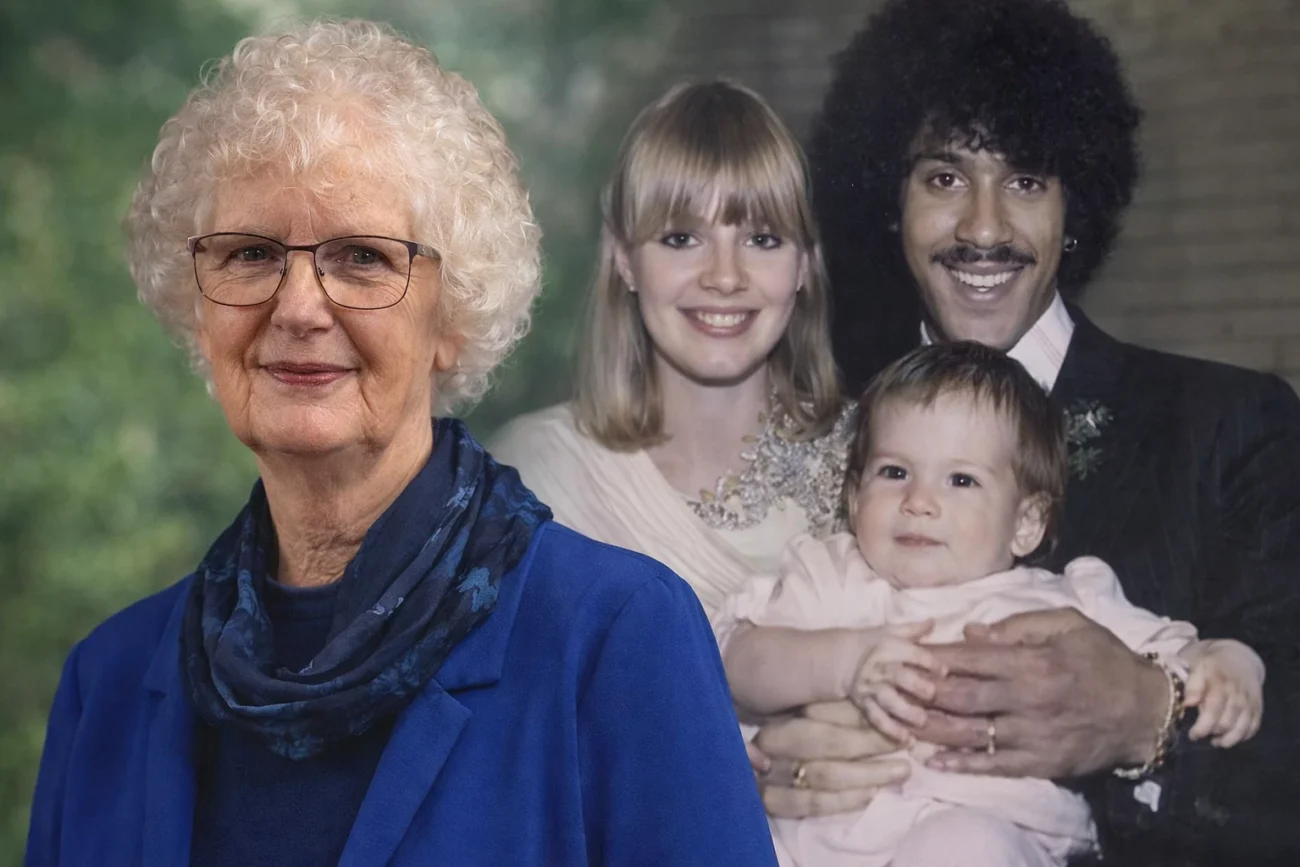
Caroline Crowther has spent most of her life in close proximity to fame without ever fully stepping into it. Her name surfaces in connection with two recognizable figures: her father, British television entertainer Leslie Crowther, and her former husband, Phil Lynott, the charismatic frontman of Thin Lizzy. Yet the most accurate portrait of Caroline Crowther is not that of a celebrity in her own right, but of a woman who lived at the intersection of public attention and private responsibility—and chose, largely, to remain on the latter side of that line.
For readers who come across her name, the curiosity is understandable. Phil Lynott remains one of Ireland’s most enduring musical icons, and interest in his personal life has never entirely faded. Caroline Crowther’s role in that story—wife, mother of his children, and later a quiet guardian of parts of his legacy—makes her an important, if often understated, figure. What emerges from the available record is not a conventional celebrity biography, but something more restrained and, in many ways, more revealing.
Early Life and Family Background
Caroline Crowther was born into a family already familiar with public life. Her father, Leslie Crowther, was a prominent British television personality, widely known for his work as a comedian, actor, and game show host. He became a household name in the UK through programs such as The Price Is Right, bringing warmth and accessibility to mainstream entertainment during the 1970s and 1980s. Growing up in that environment meant Caroline was exposed early to the rhythms and pressures of show business, even if she did not actively pursue it as a career.
Despite her father’s public profile, detailed accounts of Caroline’s childhood remain limited. There is no widely documented record of her schooling, early ambitions, or professional training, which reflects both the era she grew up in and her own later preference for privacy. What can be inferred is that she grew up in a setting where media attention was familiar but not necessarily something to seek out. That distinction would shape how she navigated the rest of her life.
The Crowther household was one of several children, and Caroline was one of Leslie Crowther’s daughters. Her upbringing in a large, entertainment-connected family likely provided both opportunity and constraint. Fame was close at hand, but it was also something to be managed carefully rather than embraced without question.
Entering the Music World
Caroline Crowther’s connection to Phil Lynott began through work rather than chance glamour. By the late 1970s, she was employed in a role connected to publicity or public relations, placing her within the professional orbit of the music industry. Thin Lizzy, already an established band by that point, was part of that environment.
Accounts of their first interaction are modest and grounded. Caroline later recalled that she initially spoke to Lynott over the phone, describing his voice as relaxed, almost as if he were still in bed. It is a small detail, but one that hints at the informal, human beginnings of a relationship that would later attract significant attention.
This origin story stands out because it contrasts with the more dramatic narratives often attached to rock stars. There is no suggestion of spectacle or immediate intensity. Instead, their relationship appears to have developed in the ordinary spaces where work and personal life intersect. That foundation would later matter as they built a family together.
Marriage to Phil Lynott
Caroline Crowther and Phil Lynott married in 1980, at a time when Lynott’s career was still active and demanding. Thin Lizzy had already achieved major success, and Lynott himself was widely recognized not only as a musician but as a cultural figure in Ireland and beyond. Their marriage placed Caroline directly within the public gaze, even if she did not actively seek it.
The early years of their marriage were shaped by the realities of Lynott’s profession. Touring, recording, and media commitments required long periods away from home, leaving Caroline to manage much of the day-to-day life on her own. They established a home in Sutton, a coastal suburb of Dublin, which became the base for their family life.
The marriage also brought moments of visible happiness, particularly with the arrival of their children. Yet it existed alongside the pressures that often accompany life in the music industry. By 1984, the relationship had broken down, and the couple separated. While the reasons for the separation have been discussed in various accounts, much of that detail remains either speculative or shaped by retrospective interpretation.
Motherhood and Family Life
One of the most enduring aspects of Caroline Crowther’s story is her role as a mother. She and Phil Lynott had two daughters, Sarah and Cathleen, who have remained closely associated with their father’s legacy. Their presence in Lynott’s life was not only personal but also artistic, reflected in the songs he wrote for them.
The song “Sarah,” in particular, became one of Lynott’s most recognizable and emotionally resonant works. It offered a rare glimpse into his life beyond the stage, revealing a softer, more intimate side. Caroline later shared that she had encouraged Lynott to write a song for their younger daughter as well, leading to “Cathleen.” These moments illustrate the influence she had within the family dynamic, even if it was not always visible to the public.
Raising two young children in the context of a high-profile marriage—and later as a separated parent—required resilience. Much of this period of Caroline’s life unfolded away from cameras and headlines, which has contributed to the relative lack of detailed documentation. What remains clear is that she maintained a focus on providing stability for her daughters during a time of significant change.
Life After the Marriage
Following the breakdown of her marriage to Phil Lynott, Caroline Crowther stepped even further away from public visibility. Unlike many individuals connected to high-profile figures, she did not pursue media attention or attempt to build a public persona based on her past relationship. Instead, she appears to have prioritized privacy and family life.
When Phil Lynott died on January 4, 1986, at the age of 36, Caroline was present as part of the immediate family during the funeral. She attended with their daughters, who were still very young at the time. The moment marked a significant turning point, not only in the public memory of Lynott but also in Caroline’s personal life.
After his death, Caroline’s public appearances became even more infrequent. There is little verified information about her professional activities or personal relationships in the years that followed. This absence of detail has led to speculation in some corners of the internet, but credible sources tend to avoid making claims that cannot be substantiated.
Relationship to Phil Lynott’s Legacy
Although Caroline Crowther has largely remained out of the spotlight, she has not been entirely absent from efforts to preserve Phil Lynott’s legacy. Her involvement has been selective, often tied to projects that aim to present a more balanced and personal view of his life.
One of the most significant examples of this is the 2020 documentary Songs for While I’m Away, directed by Emer Reynolds. The film sought to explore Lynott’s life beyond the stage, incorporating perspectives from family members as well as fellow musicians. Caroline’s participation, along with that of her daughters, added depth to the narrative.
In interviews connected to the documentary, she spoke candidly about aspects of their life together, including the challenges of managing a household while Lynott’s career kept him frequently away. These contributions helped shift the public understanding of Lynott from a purely iconic figure to a more complex individual with personal responsibilities and struggles.
Public Image and Media Portrayal
Caroline Crowther’s public image is shaped as much by what is not known as by what is. In an age where many figures connected to celebrities become subjects of extensive coverage, her relative absence stands out. It reflects both her personal choices and the limits of the available record.
Media portrayals of her tend to focus on her connections rather than her individuality. She is often described as Phil Lynott’s wife or Leslie Crowther’s daughter, which, while accurate, does not fully capture her own experience. This framing is common in celebrity culture, where the stories of those adjacent to fame are often filtered through the achievements of others.
At the same time, there has been a noticeable shift in more recent years toward recognizing her role in shaping the personal narrative around Lynott. Her contributions to documentary projects and family accounts have added dimension to a story that might otherwise remain one-sided.
Financial Status and Net Worth
There is no publicly verified figure for Caroline Crowther’s net worth. Any estimates that circulate online are speculative and should be treated with caution. Unlike many public figures, she has not been associated with widely documented business ventures or high-profile financial activities.
It is possible that her financial situation has been influenced by her connection to Phil Lynott’s estate, particularly in relation to their daughters. However, details about estate arrangements and financial distributions are not fully public. Without reliable documentation, it is not possible to provide a definitive assessment.
This lack of financial transparency is consistent with her broader approach to privacy. It also highlights the difference between verified information and the assumptions that often fill gaps in celebrity-related content.
Where Caroline Crowther Is Now
The question of where Caroline Crowther is today is one of the most frequently searched aspects of her life. The honest answer is that she has remained largely private. There are occasional appearances connected to events honoring Phil Lynott, including screenings of Songs for While I’m Away and related discussions.
These appearances suggest that she continues to play a role in preserving and contextualizing Lynott’s legacy, particularly alongside her daughters. Beyond that, there is little confirmed information about her day-to-day life, residence, or professional activities.
Her decision to maintain that level of privacy is consistent with the pattern established over decades. It reflects a deliberate choice to engage with public life on her own terms, rather than as a continuous presence.
Frequently Asked Questions
Who is Caroline Crowther?
Caroline Crowther is known primarily for her marriage to Phil Lynott, the lead singer of Thin Lizzy, and as the daughter of British television entertainer Leslie Crowther. She has remained largely private despite her connections to well-known public figures.
Was Caroline Crowther married to Phil Lynott?
Yes, Caroline Crowther married Phil Lynott in 1980. Their marriage lasted several years before they separated in 1984, and they had two children together during that time.
How many children does Caroline Crowther have?
Caroline Crowther has two daughters, Sarah and Cathleen Lynott. Both have been involved in preserving their father’s legacy and have appeared in documentary projects about his life.
What is Caroline Crowther’s relationship to Leslie Crowther?
Caroline Crowther is one of the daughters of Leslie Crowther, a well-known British television host and entertainer. His career in television made him a familiar figure in the UK during the 20th century.
Did Caroline Crowther appear in any documentaries?
Yes, she appeared in the 2020 documentary Songs for While I’m Away, which explores the life and career of Phil Lynott. Her contributions helped provide a family perspective on his story.
What is known about Caroline Crowther’s net worth?
There is no verified public information about Caroline Crowther’s net worth. Any figures found online are speculative and not supported by reliable sources.
Where is Caroline Crowther now?
Caroline Crowther has maintained a private life in recent years. She occasionally appears at events related to Phil Lynott’s legacy but does not have a regular public presence.
Conclusion
Caroline Crowther’s life does not follow the arc of a typical public figure. She has moved alongside fame without fully entering it, maintaining a distance that has preserved both her privacy and a certain clarity in how she is understood. Her story is defined less by visibility than by presence—particularly within the context of her family.
Her role in Phil Lynott’s life and legacy remains significant, not because of constant public engagement, but because of the perspective she offers when she does speak. Through her, and through her daughters, a fuller picture of Lynott continues to emerge, one that balances admiration with reality.
There is a quiet strength in that position. In a culture that often rewards constant exposure, Caroline Crowther’s life stands as an example of a different path—one where connection to fame does not require surrendering to it.
What remains, ultimately, is a portrait shaped by restraint. It is a story told in fragments, but those fragments carry weight, offering a glimpse into a life lived close to the spotlight, yet firmly grounded outside it.
