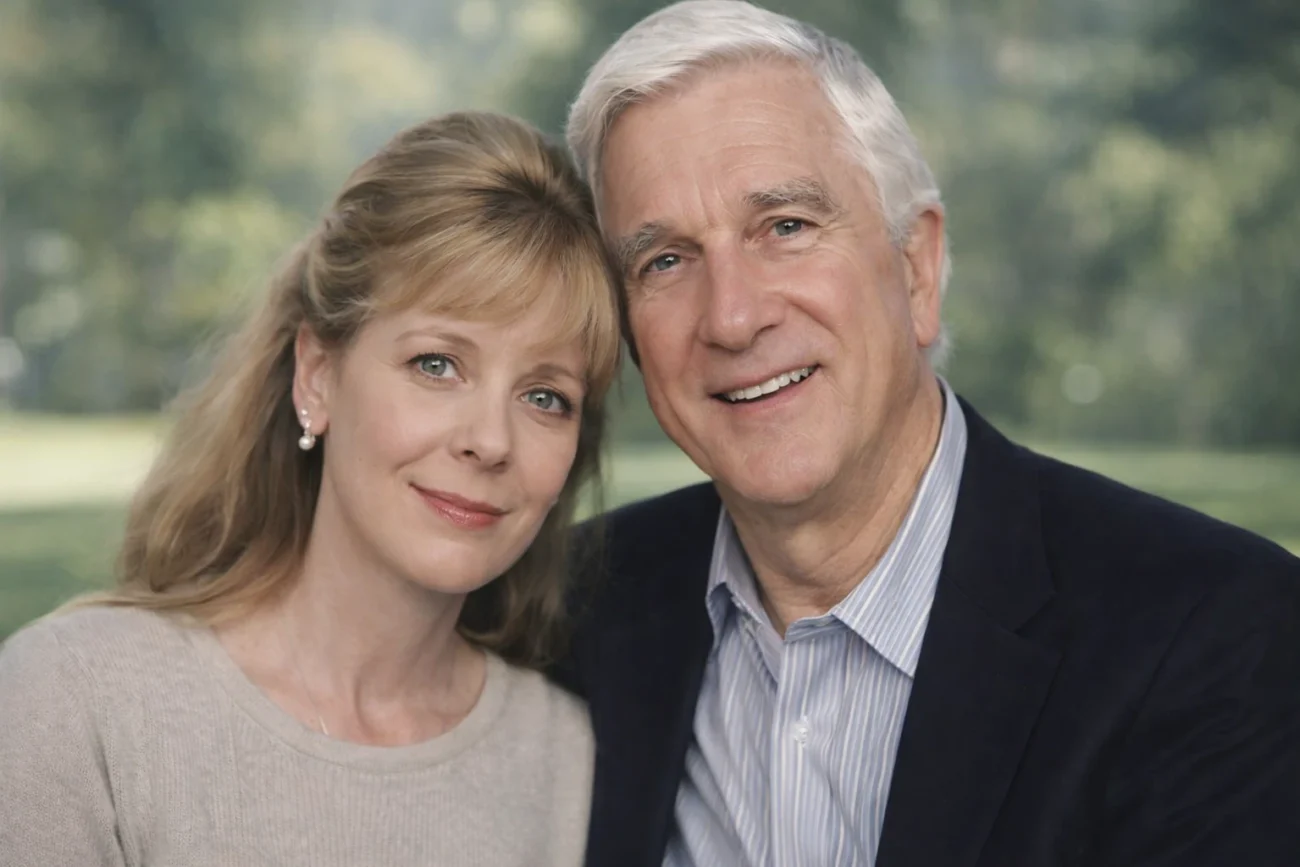
In the long arc of Hollywood history, there are people whose lives are carefully documented and others who appear only in the margins—visible, yet elusive. Alisande Ullman belongs to the second group. Her name surfaces most often in connection with actor Leslie Nielsen, a man whose career spanned decades and transformed him into a comedy icon. But Ullman herself remains a far quieter figure, one whose story must be pieced together from scattered records, period accounts, and the few verifiable facts that have endured.
What emerges is not a tale of celebrity ambition or public spectacle, but something more restrained: a life briefly adjacent to Hollywood’s spotlight before receding into privacy. That absence of noise has, in recent years, created confusion as much as curiosity. To understand who Alisande Ullman was—and why people still search for her name—you have to begin with what can actually be confirmed, and then carefully trace the edges of what remains unknown.
Early Life and Background
Publicly verified information about Alisande Ullman’s early life is limited, and that limitation is important to acknowledge. Unlike many figures tied to the entertainment world, Ullman did not maintain a sustained public presence that generated detailed biographical records. As a result, specifics such as her exact birth date, parents, or schooling are not consistently documented in reliable sources.
One of the few period references that sheds light on her background comes from a late-1950s magazine feature, which identifies her as being from Philadelphia. In that account, she is described as a working woman in Hollywood rather than someone born into the industry. She held a job as a secretary at MGM, placing her within the studio system at a time when such roles were often stepping stones—or simply steady employment—in a highly stratified entertainment environment.
That context matters. The Hollywood of the 1950s was structured around studios, contracts, and rigid hierarchies. Secretaries and administrative staff were part of the daily machinery of the film business, but rarely part of its public narrative. Ullman’s position suggests a life grounded in ordinary routines rather than the glamour associated with actors and stars, even as she moved within the same physical spaces.
Meeting Leslie Nielsen
Alisande Ullman’s life intersects with the public record most clearly through her relationship with Leslie Nielsen. By the late 1950s, Nielsen was a rising actor working in film and television, known for dramatic roles long before he became famous for comedy. Their meeting, according to contemporaneous accounts, took place within the MGM environment where Ullman worked.
The relationship did not follow the rushed trajectory often associated with Hollywood romances. The magazine feature from that period describes a courtship that lasted roughly two years, suggesting a more gradual connection built through repeated encounters and shared social circles. The portrayal is domestic and grounded: dinners, conversations, and a relationship that unfolded away from the public eye.
They married on September 10, 1958, marking the beginning of what would become Nielsen’s second marriage. For Ullman, it was the moment when her private life briefly intersected with a public figure whose career would later grow far beyond its early promise. Yet even at the time, the marriage did not transform her into a widely recognized personality.
Marriage and Family Life
The marriage between Alisande Ullman and Leslie Nielsen lasted roughly 15 to 16 years, ending in the early 1970s, with several reliable sources placing the divorce in 1974. During that time, the couple had two daughters: Thea and Maura. These family connections are among the most consistently verified details of Ullman’s life, appearing in both entertainment databases and obituary records related to Nielsen.
Their family life, as described in the limited period sources available, appears to have been relatively conventional. The same late-1950s feature presents Ullman as someone who enjoyed cooking, hosting friends, and maintaining a home environment that contrasted with the public-facing demands of Nielsen’s career. While such portrayals reflect the norms and expectations of the era, they also suggest that Ullman’s identity was rooted more in private roles than in professional visibility.
Not many people know this, but Nielsen’s career during much of their marriage was far removed from the comedic persona he later became known for. In the 1950s and 1960s, he was primarily cast in dramatic roles, often as a serious leading man. That context places Ullman’s time with him in a different phase of his life—one that is less widely remembered today, but crucial to understanding the trajectory of both their lives.
The marriage ended without significant public scandal, at least as far as the reliable record shows. Unlike many Hollywood divorces that become media events, this separation appears to have unfolded quietly. That lack of public conflict aligns with the broader pattern of Ullman’s life: visible in connection with Nielsen, but never the subject of sustained public attention.
A Brief Public Appearance
Although Alisande Ullman was not a public figure in the traditional sense, she does have a small but documented presence in entertainment records. She is credited with appearing as herself on the television game show It Takes Two, a program that featured celebrity couples.
This appearance is significant less for its content than for what it represents. It confirms that Ullman did, at least occasionally, step into the public eye alongside her husband. At the same time, the rarity of such appearances reinforces the broader picture of her life as largely private.
Here’s where it gets interesting. In an era when many spouses of actors pursued careers of their own or became public personalities through association, Ullman did not follow that path. Her limited screen presence suggests either a personal preference for privacy or a deliberate choice to remain outside the entertainment industry’s spotlight.
Life After Divorce
After her divorce from Leslie Nielsen, Alisande Ullman largely disappears from the public record. This absence has led to a proliferation of speculation in recent years, as various websites attempt to fill in the gaps with unverified claims about her later life, career, and personal circumstances.
The truth is more restrained. There is no strong, widely accepted documentation of her activities after the mid-1970s. No confirmed interviews, public appearances, or professional records have emerged in reliable sources that would allow for a detailed account of her post-divorce life.
That silence should not be mistaken for mystery in the dramatic sense. Many individuals connected to public figures choose, or naturally drift into, private lives once those connections end. In Ullman’s case, the lack of verifiable information suggests that she did exactly that.
What’s surprising is how often this absence is misinterpreted. The internet tends to reward complete narratives, even when they are unsupported. As a result, Ullman’s life has been the subject of numerous speculative biographies that present detailed accounts without clear sourcing. A careful reading shows that these accounts often contradict one another, reinforcing the need for caution.
Her Children and Continuing Connections
While Alisande Ullman herself remained largely out of the public eye, her children provide a limited but meaningful link to the entertainment world. Her daughter Maura Nielsen Kaplan has appeared in several film projects, including titles connected to her father’s later career.
These connections do not place Ullman back into the spotlight, but they do show that her family remained tied, at least indirectly, to the industry that shaped a significant part of her life. Her other daughter, Thea Nielsen Disney, has also been referenced in entertainment-related contexts, though detailed public information about her life remains limited.
Family ties often serve as the most durable traces in cases like Ullman’s. They offer continuity where direct documentation fades, providing a way to understand how a person’s life intersects with broader cultural and professional networks.
Public Image and Misconceptions
Alisande Ullman’s public image is unusual because it is shaped as much by absence as by presence. Without a large body of verified information, her identity has become vulnerable to distortion. Some online sources have incorrectly linked her to other actors or assigned her careers and achievements that do not appear in reliable records.
These errors are not trivial. They highlight a broader issue in digital biography writing, where repetition can create the illusion of truth. Once a detail appears on multiple sites, it begins to look credible, even if all those sites are drawing from the same unverified origin.
The truth is, Ullman’s story does not need embellishment to be meaningful. Her life offers a perspective on what it means to exist near fame without becoming defined by it. That perspective is less dramatic than many online narratives suggest, but it is also more honest.
Financial Standing and Net Worth
There is no publicly confirmed information about Alisande Ullman’s personal net worth. Any figures that appear online should be treated as speculative unless supported by credible financial disclosures or reporting, which do not exist in this case.
What can be said is that her financial circumstances during her marriage would have been influenced by Leslie Nielsen’s career, which grew steadily over time. After their divorce, however, there is no reliable public data about her income sources, assets, or financial status.
This lack of information is consistent with her overall profile. Individuals who do not maintain public careers or business ventures rarely leave behind detailed financial records accessible to the public. As a result, any attempt to assign a specific net worth to Ullman is likely to be guesswork rather than fact.
Why Alisande Ullman Still Matters
It may seem unusual that a person with such a limited public record continues to attract attention. But the answer lies in the enduring interest in the lives of those connected to well-known figures. Leslie Nielsen’s legacy, particularly his later work in comedy, has kept his personal life in the public conversation long after his death.
Alisande Ullman represents a part of that story that is both real and incomplete. She was there during a formative period of Nielsen’s career, shared in his life for more than a decade, and raised a family with him. Yet she did so without becoming a public figure in her own right.
The truth is, her significance comes not from what she did publicly, but from what her story reveals about the boundaries of fame. Not everyone who enters the orbit of a celebrity becomes part of the public narrative in a lasting way. Ullman’s life shows how those boundaries can hold, even in an industry that often blurs them.
Where Alisande Ullman Is Now
There is no confirmed, up-to-date public information about Alisande Ullman’s current status or whereabouts. This absence is consistent with the pattern of her life since the 1970s, during which she appears to have maintained a high degree of privacy.
While some websites claim to know details about her later years, these claims are not supported by strong evidence. Without reliable documentation, the most accurate answer is simply that her current life remains private.
That may feel unsatisfying in a culture that expects complete biographies. But it is also a reminder that not every story is fully accessible, and not every life is meant to be publicly documented in detail.
Frequently Asked Questions
Who is Alisande Ullman?
Alisande Ullman is best known as the second wife of actor Leslie Nielsen. She was married to him from 1958 until the mid-1970s and is the mother of his two daughters. Beyond that connection, she maintained a largely private life.
Did Alisande Ullman have a career in Hollywood?
There is no strong evidence that she pursued a significant acting or entertainment career. She is credited with a brief appearance as herself on a television game show, but her primary connection to Hollywood came through her marriage to Nielsen.
How long was Alisande Ullman married to Leslie Nielsen?
They were married for approximately 15 to 16 years. Most reliable sources place the marriage beginning in 1958 and ending in 1974.
Did Alisande Ullman have children?
Yes, she had two daughters with Leslie Nielsen: Thea and Maura. Both have been referenced in entertainment-related contexts, particularly through family connections.
What is known about her early life?
Very little is confirmed. A period magazine feature describes her as being from Philadelphia and working as a secretary at MGM, but detailed information about her upbringing is not widely documented.
What is Alisande Ullman’s net worth?
There is no verified public information about her net worth. Any figures found online are speculative and not supported by reliable sources.
Where is Alisande Ullman now?
Her current status and whereabouts are not publicly confirmed. She appears to have lived a private life outside the public eye since her divorce from Leslie Nielsen.
Conclusion
Alisande Ullman’s story is not one of fame, but of proximity to it. She entered the public record through her marriage to a rising actor, lived within the orbit of Hollywood for a time, and then stepped away. What remains is a set of verified facts that outline her place in that history without filling in every detail.
There is a tendency to treat incomplete biographies as puzzles waiting to be solved. But sometimes, the gaps are not mysteries but boundaries. Ullman’s life reminds us that privacy can endure, even in an age that documents almost everything.
Her significance lies not in a list of achievements or public milestones, but in the quieter narrative she represents. She is part of a broader story about the people who move alongside fame without being consumed by it.
That perspective is easy to overlook, but it is worth holding onto. In a world where visibility often defines importance, Alisande Ullman’s life suggests another measure: the ability to remain, simply and deliberately, outside the spotlight.
