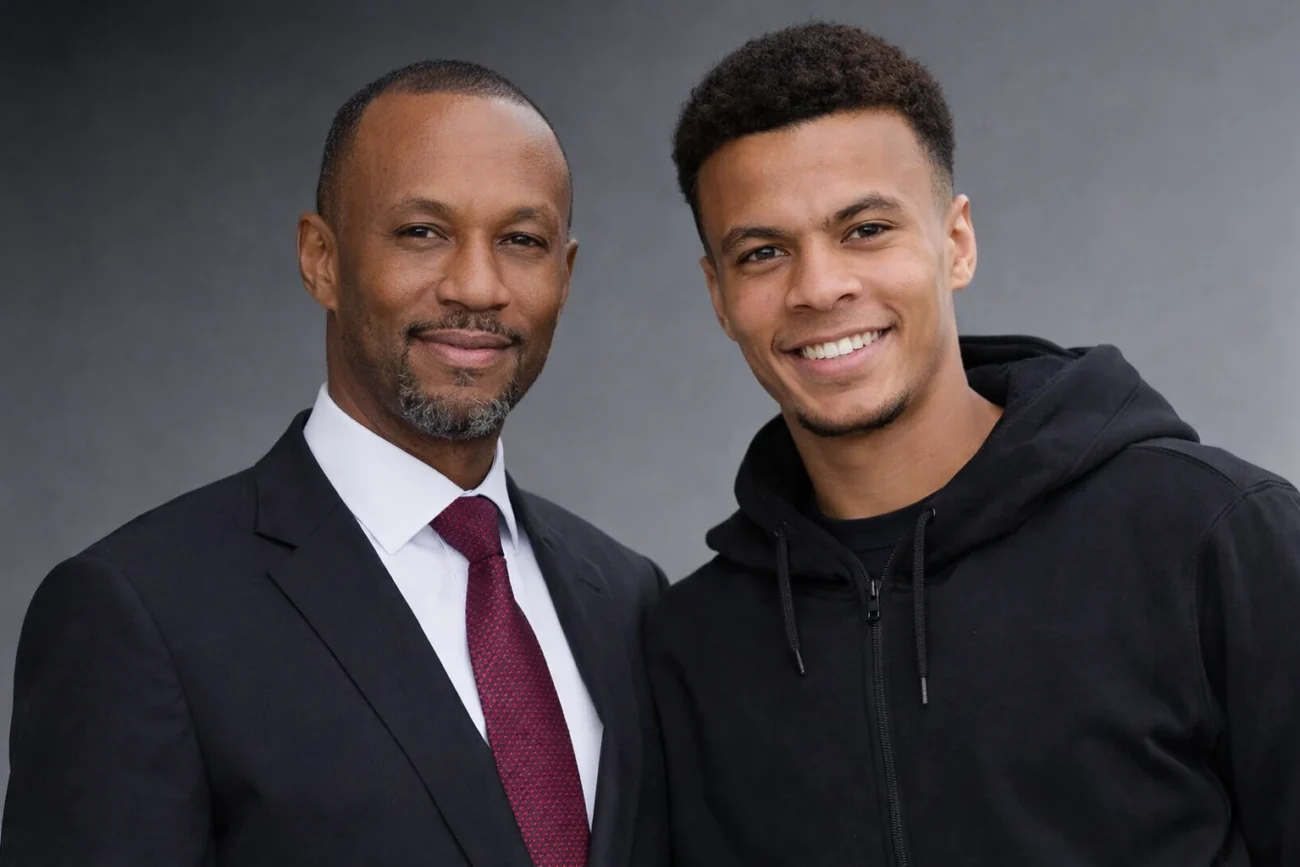
For most of the world, the name Kehinde Alli only surfaces in moments of reflection—usually when his son, footballer Dele Alli, speaks about his childhood, his identity, or the complicated path that shaped him. It is a name that appears not through headlines of its own, but through another life lived in full public view. And yet, that indirect visibility has turned Kehinde Alli into a subject of quiet fascination, one defined as much by absence and distance as by fact.
Unlike many figures tied to celebrity families, Kehinde Alli has not built a public persona. He has not cultivated interviews, business profiles, or a visible career narrative that can be traced through media archives. What exists instead is a partial biography, assembled from fragments of reporting, brief mentions in interviews, and the emotional weight of a father-son relationship that has remained strained. To understand Kehinde Alli is not to uncover a traditional success story, but to examine how a largely private life intersects with a widely told one.
Early Life and Background
Publicly verified information about Kehinde Alli’s early life is limited. He is widely described in reputable reporting as Nigerian-born, with ties to Nigeria that remained part of his life well into adulthood. Some accounts suggest he later lived in the United States, including Texas, but detailed records of his upbringing, education, or early ambitions are not well documented in mainstream sources.
That lack of detail has allowed a parallel narrative to grow online, one that often fills in gaps with speculation. Various websites attribute specific birth dates, hometowns, and family lineages to him, sometimes even suggesting royal connections. But these claims rarely point to primary sources or independently verifiable records, making them difficult to confirm with confidence. The truth is simpler and more cautious: Kehinde Alli’s early life remains largely private, and what can be said with certainty is far narrower than what is often claimed.
What is known is that he is of Nigerian origin and became connected to the United Kingdom through his relationship with Denise Alli, an English woman who would become the mother of his son. That relationship, and the child it produced, would later anchor his name in public memory.
Relationship with Denise Alli and Family Beginnings
Kehinde Alli’s most publicly acknowledged relationship is with Denise Alli, Dele Alli’s mother. Their relationship resulted in the birth of Dele Alli in April 1996 in Milton Keynes, England. At the time, their circumstances were not widely documented, and the details of their relationship have not been extensively shared in public reporting.
What is clear is that their partnership did not lead to a stable long-term family structure. Accounts from credible outlets suggest that Kehinde left England shortly after Dele’s birth, returning to his own pursuits abroad. The reasons for this separation have not been fully explained in public, and neither party has offered a detailed, mutual account of that period.
The absence of a sustained parental partnership would later become a defining aspect of Dele Alli’s childhood narrative. For Kehinde, it meant that his role in his son’s early years was limited and largely shaped by distance rather than daily presence. For readers trying to piece together his biography, this period is less about documented events and more about understanding how an early separation set the tone for what followed.
Fatherhood and Distance
The most consistent thread connecting Kehinde Alli to public discourse is his role as Dele Alli’s father—and the distance that defined that relationship. Reporting indicates that Dele spent part of his childhood in Nigeria with his father, an experience that has been referenced in multiple interviews. Dele himself later described being sent there to “learn discipline,” a phrase that hints at both cultural expectations and family dynamics that are not fully visible from the outside.
Those years in Nigeria are often mentioned, but rarely explored in detail. There is no widely available record of what daily life looked like during that time, or how the father-son relationship functioned beyond broad descriptions. What remains is the fact of the experience itself, and its place within a larger, unsettled childhood.
By the time Dele returned to England, his life took a different direction. At the age of 13, he was taken in by Alan and Sally Hickford, a family who would become central to his upbringing and development. This transition effectively marked a shift away from both biological parents, including Kehinde. It also reinforced the sense that Kehinde’s presence in Dele’s life, while real, was intermittent and incomplete.
A Name That Became a Statement
One of the most visible moments linking Kehinde Alli to public attention came years later, when Dele made a decision that resonated far beyond football. In 2016, while playing for Tottenham Hotspur, he chose to remove “Alli” from the back of his shirt and replace it with his first name, “Dele.”
The decision was not about branding or style. It was, by Dele’s own explanation, about identity. He said he felt no strong connection to the surname “Alli” and wanted to represent himself in a way that felt more authentic. For observers, the change was subtle but powerful—a public signal of a personal boundary.
That moment placed Kehinde Alli, indirectly, at the center of a broader conversation. It turned a private family dynamic into a visible symbol seen by millions of football fans. The absence of the surname raised questions about belonging, heritage, and how individuals define themselves when family ties are complicated.
For Kehinde, who had no public platform to respond or explain, the moment underscored his position as a largely silent figure within a very loud story.
Public Image Through Dele Alli’s Story
Kehinde Alli’s public image is almost entirely shaped by the way his son has described their relationship. This is an unusual dynamic, but not a rare one in the context of celebrity families. When one person lives in the spotlight and the other does not, the narrative often flows in one direction.
Dele Alli has spoken candidly in recent years about his childhood struggles, including experiences of instability, trauma, and feelings of abandonment. In a widely viewed 2023 interview, he described a difficult upbringing and spoke about feeling betrayed by his biological parents. While he did not offer a detailed account of his father’s perspective, the emotional weight of his words left little doubt about the impact of those early years.
It is important to approach these accounts with care. Dele’s testimony is deeply personal and carries significant authority as lived experience. At the same time, it represents one side of a private relationship. Without public statements or detailed accounts from Kehinde himself, the full picture remains incomplete.
What can be said is that Dele’s story has defined how the world sees Kehinde Alli. It has turned him into a figure associated with absence and distance, even as the specifics of his own life remain largely unknown.
The Question of Career and Wealth
Another area where uncertainty persists is Kehinde Alli’s professional life. Some reports describe him as a businessman, a label that appears in reputable coverage but is rarely expanded upon. There is no widely available record of companies he has founded, industries he has worked in, or ventures he has led.
This gap has been filled online by a wide range of claims, including assertions about significant wealth or high-profile business success. As with other aspects of his biography, these claims often lack clear sourcing. They may reflect assumptions based on diaspora success narratives or simply the tendency of online content to amplify unverified details.
Without strong, verifiable evidence, it is not possible to present a precise account of Kehinde Alli’s financial standing. Estimates of net worth that circulate online should be treated as speculative rather than factual. The most reliable conclusion is that his professional life has not been documented in detail by mainstream, credible sources.
Life Outside the Spotlight
What’s striking about Kehinde Alli is how much of his life remains outside public view, even as his name circulates widely online. In an age where personal histories are often documented in exhaustive detail, his relative privacy stands out.
There are no widely reported public appearances, interviews, or social media profiles that offer insight into his daily life, beliefs, or current activities. This absence can be frustrating for readers seeking a complete picture, but it also reflects a deliberate or circumstantial distance from public life.
That distance raises an interesting question about how we define relevance. Kehinde Alli matters in public discourse not because of what he has chosen to share, but because of how his life intersects with a widely followed figure. It is a form of visibility that is indirect, shaped by connection rather than self-presentation.
Cultural Context and Identity
Kehinde Alli’s story cannot be separated from its cultural context. As a Nigerian-born father whose son grew up in England, his place in the narrative touches on themes of migration, identity, and belonging. These themes are not unique to his family, but they take on a particular resonance in Dele Alli’s story.
For many readers, the interest in Kehinde Alli is partly about understanding how cross-cultural family dynamics play out over time. The movement between countries, the expectations placed on children, and the challenges of maintaining relationships across distance all form part of the background.
That said, it would be a mistake to turn Kehinde into a symbol of any broader cultural narrative without sufficient evidence. His story is specific, shaped by individual circumstances that are not fully visible from the outside. The cultural context adds depth, but it does not provide a complete explanation.
Where Kehinde Alli Is Now
There is no definitive, widely confirmed public update on Kehinde Alli’s current life. Some reports suggest he continues to reside in the United States, but detailed information about his present circumstances is scarce.
This lack of current information reinforces a broader pattern. Kehinde Alli has remained largely out of the public eye, even as interest in his name has grown. His story, as it exists in public, is anchored in the past and in his connection to his son, rather than in ongoing public activity.
For readers, this means that the most recent chapter of his life is also the least documented. It is a reminder that not all figures connected to fame choose or achieve visibility, and that some lives remain largely private despite public curiosity.
Frequently Asked Questions
Who is Kehinde Alli?
Kehinde Alli is best known as the biological father of English footballer Dele Alli. He is Nigerian-born and has been described in credible reporting as a businessman, though details about his career are limited.
What is Kehinde Alli known for?
He is known primarily because of his connection to Dele Alli and the role he played in his son’s early life. His name often appears in discussions about Dele’s upbringing and family background.
Did Kehinde Alli raise Dele Alli?
Dele Alli spent part of his childhood with his father in Nigeria, but he was largely raised in England. At the age of 13, he was taken in by the Hickford family, who became his primary caregivers.
Why did Dele Alli drop the name “Alli”?
Dele Alli said he felt no strong connection to the surname and chose to use his first name instead. The decision reflected his personal identity and his relationship with his family.
What does Kehinde Alli do for a living?
He has been described as a businessman, but there is no detailed, publicly verified record of his professional activities. Many claims about his career online are not well sourced.
Is Kehinde Alli wealthy?
There are online claims about his wealth, but these are not backed by strong, verifiable evidence. Any estimates of his net worth should be treated as speculative.
Conclusion
Kehinde Alli’s biography is defined as much by what is unknown as by what is known. He is a figure who exists at the edge of public awareness, brought into view by his son’s story rather than by his own actions in the spotlight.
What emerges from the available record is a portrait of distance—geographical, emotional, and narrative. His life intersects with one of football’s most compelling personal stories, yet it remains largely private and only partially understood.
There is a temptation to fill in the gaps with certainty, to turn fragments into a full narrative. But the truth is quieter and more restrained. Kehinde Alli’s place in public discourse is real, but it is also limited, shaped by connection rather than exposure.
For readers, the value lies not in uncovering every detail, but in understanding the boundaries of what can be known. In a world that often rewards overstatement, there is something honest about a story that remains incomplete.
