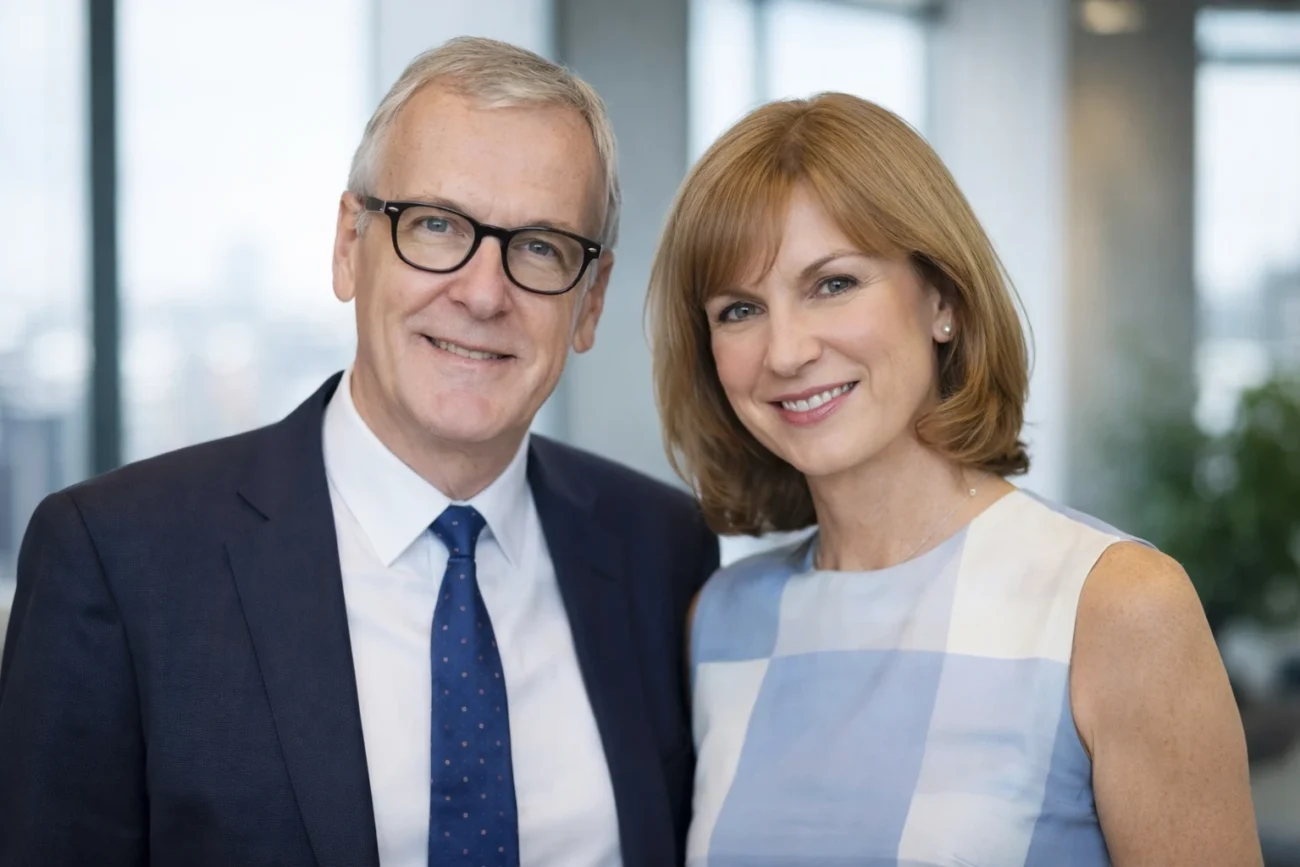
Nigel Sharrocks has spent much of his professional life shaping the media world from behind the scenes, the kind of influence that rarely produces headlines but quietly alters how industries function. His name surfaces in boardrooms, annual reports and industry conferences rather than on television screens, yet his decisions have intersected with some of the most significant shifts in British and global media over the past three decades. For many readers, he is also known as the husband of broadcaster Fiona Bruce, a connection that brings him occasional public attention. But the deeper story is about a career built on leadership across advertising, film distribution, media networks and audience measurement at a time when all of those sectors were being rewritten.
Sharrocks belongs to a generation of media executives who moved through multiple layers of the business as it evolved from traditional advertising into a more fragmented, data-driven system. His career is not defined by a single breakthrough moment or one defining company. Instead, it is marked by a series of senior roles that collectively map onto the broader changes in how media is financed, distributed and measured. Understanding his trajectory offers a way to understand the industry itself.
Early Life and Family Background
Nigel Sharrocks was born in August 1956 in the United Kingdom, though detailed public records about his early life remain limited. Unlike many public figures, he has never built a persona around his upbringing, and there is little verified information about his parents, childhood or early environment. This absence is not unusual for executives who came of age before the modern culture of personal branding and social media exposure.
What can be said with reasonable confidence is that Sharrocks grew up in a Britain that was still dominated by traditional media structures. Television was tightly controlled, advertising followed well-established agency models, and cinema was navigating the early stages of modern commercial reinvention. Those conditions would later form the backdrop against which he built his career.
There is also little publicly confirmed information about his formal education. Some sources suggest he attended British institutions typical of business or media professionals of his generation, but these claims are not consistently verified across reliable records. What stands out more clearly is that his early professional steps placed him squarely in the advertising world, which suggests a pathway shaped more by industry entry than by public academic distinction.
Early Career in Advertising
Sharrocks’ career began in advertising, a sector that served as the foundation for many senior media executives of his era. Companies House records link him to Grey Advertising and related firms during the 1990s, placing him within one of the established global agency networks of the time. Advertising in that period was still largely driven by television and print, with media buying and creative services closely tied together.
Working within that environment would have required both commercial awareness and an ability to manage client relationships at scale. Agencies like Grey were responsible not just for campaigns but for broader brand positioning, and executives rising through those ranks were often exposed to the financial and strategic pressures that shaped major corporate decisions. For Sharrocks, this period appears to have laid the groundwork for his later roles in larger, more complex organizations.
The truth is that advertising in the 1990s was already beginning to change. Early digital channels were emerging, and media fragmentation was starting to challenge traditional planning models. Executives who adapted during this period often went on to lead the next phase of the industry, and Sharrocks’ subsequent career suggests he was among those who made that transition successfully.
Moving Into Film Distribution
One of the defining shifts in Sharrocks’ career came with his move into film distribution, most prominently through his role as managing director of Warner Bros. Entertainment UK. Public records confirm his involvement with the company between 1999 and 2004, a period when Hollywood studios were strengthening their global distribution strategies and investing heavily in international markets.
This role placed him at the intersection of marketing, exhibition and content distribution. The early 2000s were a time when blockbuster franchises were becoming central to studio strategy, and the UK market was a key part of that global ecosystem. Managing a major studio’s operations in Britain would have involved coordinating film releases, overseeing marketing campaigns and working closely with cinema chains.
Not many executives move from advertising into studio leadership, but the transition makes sense when viewed through the lens of marketing expertise. Film distribution relies heavily on advertising and audience targeting, and Sharrocks’ background would have been directly relevant. His time at Warner Bros. also marked his first major exposure to the entertainment industry at scale, a theme that would continue throughout his career.
Leadership at Aegis Media
Sharrocks’ next significant chapter came at Aegis Media, where he rose to become chief executive of Aegis Media Global Brands. This role placed him at the center of one of the world’s major media buying and communications groups. Aegis was known for its focus on media planning and buying, operating at a global level with clients spanning multiple industries.
His tenure coincided with a period of consolidation and expansion in the advertising sector. Media agencies were growing in scale, and global clients increasingly demanded unified strategies across markets. Sharrocks was part of the leadership team during Aegis Group’s acquisition by the Japanese advertising giant Dentsu, a deal valued at approximately $3.16 billion.
That transaction reflected a broader trend toward globalization in advertising. Companies were seeking to combine regional strengths with international reach, and leadership teams were tasked with managing complex integrations. Sharrocks’ presence at that level indicates his standing within the industry at the time, even if his public profile remained relatively low.
He retired from his executive role at Aegis in 2013, marking the end of his tenure as a day-to-day operating chief. But retirement in this context did not mean stepping away from the industry entirely. Instead, it signaled a shift toward board-level influence.
Transition to Chairman Roles
After leaving Aegis, Sharrocks moved into a series of non-executive and chairman positions, a common path for senior executives with extensive experience. These roles tend to focus on governance, strategy and oversight rather than operational management, allowing individuals to shape companies at a broader level.
One of his most prominent positions has been as non-executive chairman of Digital Cinema Media (DCM), a company that handles cinema advertising in the UK. DCM represents a collaboration between major cinema chains and provides advertisers with access to film audiences. Sharrocks has been associated with the company since 2013, suggesting a long-term role in guiding its direction.
Cinema advertising has faced challenges in the age of streaming, but it has also retained value as a premium environment for brands. Sharrocks’ involvement in DCM reflects his continued engagement with the commercial side of media, particularly in areas where traditional formats must adapt to new consumption patterns.
Chairmanship of Barb Audiences
Another key role for Sharrocks has been his chairmanship of Barb Audiences, the UK’s primary television audience measurement body. Barb is responsible for providing data that underpins advertising decisions, programming strategies and regulatory discussions across the television industry.
Audience measurement has become increasingly complex as viewing habits shift from scheduled broadcasts to on-demand and streaming platforms. Barb’s role has expanded to include cross-platform measurement, and its data is often treated as the industry standard. As chair, Sharrocks has been involved in overseeing this transition and ensuring the organization maintains credibility.
His public comments in this role emphasize the importance of independence and trust in audience data. That focus reflects broader industry concerns about transparency and accountability, particularly as digital platforms introduce new metrics that are not always directly comparable with traditional measures.
Other Business Interests and Board Roles
Sharrocks’ portfolio of roles extends beyond DCM and Barb. He has been associated with Local Planet International, a network of independent media agencies, and with Silver Bullet Data Services Group, a company focused on advertising technology and data solutions. These positions place him within the ongoing conversation about how advertising adapts to privacy regulations and the decline of third-party cookies.
The range of these roles highlights a consistent theme. Sharrocks has remained engaged with the mechanisms that connect advertisers, media owners and audiences. Whether through cinema, television measurement or digital data services, his work has centered on how media is monetized and understood.
That breadth also reflects the changing nature of the industry. Executives who once focused on a single channel now often operate across multiple platforms, responding to shifts in technology and consumer behavior. Sharrocks’ career offers a clear example of that evolution.
Marriage to Fiona Bruce and Family Life
Nigel Sharrocks’ personal life entered the public eye primarily through his marriage to Fiona Bruce, one of the UK’s most recognizable television presenters. The couple met while working in advertising and married in July 1994. Their relationship has been described in public profiles as stable and long-standing, though both have generally kept their private lives out of the spotlight.
They have two children together, and family life has remained largely private. Unlike many high-profile couples, Sharrocks and Bruce have not built a public brand around their relationship. Instead, their appearances together tend to be limited to formal events or occasional media coverage tied to Bruce’s career.
This balance between public and private life appears to be intentional. Sharrocks’ professional focus has remained firmly on business and governance, and there is little evidence that he has sought public attention beyond what comes naturally through his roles and associations.
Public Image and Industry Reputation
Sharrocks’ public image is shaped less by media coverage and more by industry perception. He is often described as a steady, experienced figure with a strong understanding of both traditional and modern media structures. That reputation aligns with his career trajectory, which spans multiple sectors and leadership levels.
What’s surprising is how little personal branding surrounds him compared to many contemporary executives. In an era when business leaders often cultivate public personas through social media and speaking engagements, Sharrocks has maintained a relatively low profile. His influence is exercised through institutions rather than personal visibility.
Industry commentary suggests that he is valued for his ability to navigate complex transitions. Whether dealing with the integration of Aegis into Dentsu or overseeing changes in audience measurement, his roles have often involved guiding organizations through periods of uncertainty.
Financial Standing and Net Worth
Reliable public information about Nigel Sharrocks’ personal wealth is limited. As a senior executive and chairman of multiple companies, it is reasonable to assume that he has accumulated significant earnings over the course of his career. However, widely circulated net worth figures are typically estimates and should be treated with caution.
Executive compensation in advertising and media can vary widely depending on roles, bonuses and equity stakes. Without detailed financial disclosures, it is difficult to assign a precise value to Sharrocks’ wealth. What can be said is that his positions at major firms and ongoing board roles place him among the upper tiers of the industry’s professional class.
Where Nigel Sharrocks Is Now
As of 2026, Nigel Sharrocks remains active in the media and advertising sector through his chairmanships and board positions. His continued involvement with Barb, DCM and other organizations indicates that he has not stepped away from the industry despite transitioning out of executive roles more than a decade ago.
His current work focuses on governance, strategy and the broader direction of media institutions. That shift reflects both his experience and the needs of the industry, which continues to grapple with rapid technological change and evolving business models.
Rather than pursuing new ventures or public-facing projects, Sharrocks appears to have settled into a role as a senior figure who provides continuity and oversight. His career, viewed in full, suggests a professional who has adapted to change while maintaining a consistent focus on the core economics of media.
Frequently Asked Questions
Who is Nigel Sharrocks?
Nigel Sharrocks is a British media and advertising executive known for his leadership roles in companies such as Warner Bros. Entertainment UK and Aegis Media. He is currently involved in several board and chairman positions within the industry.
What is Nigel Sharrocks known for?
He is known for his work in advertising, film distribution and media governance. His roles at Aegis Media and his chairmanships at Digital Cinema Media and Barb Audiences are among his most prominent contributions.
Is Nigel Sharrocks married?
Yes, Nigel Sharrocks is married to British broadcaster Fiona Bruce. The couple married in 1994 and have two children.
What does Nigel Sharrocks do now?
He serves in non-executive and chairman roles, focusing on governance and strategy for media and advertising organizations. His work includes overseeing audience measurement and cinema advertising businesses.
What is Nigel Sharrocks’ net worth?
There is no officially confirmed figure for his net worth. Estimates exist online, but they are not based on publicly verified financial disclosures.
What companies has Nigel Sharrocks worked for?
He has worked for Grey Advertising, Warner Bros. Entertainment UK and Aegis Media, among others. He has also held roles in organizations such as Digital Cinema Media, Barb Audiences and Silver Bullet Data Services Group.
Conclusion
Nigel Sharrocks’ career does not follow the familiar arc of a public figure whose story is defined by visibility. Instead, it reflects a quieter form of influence, one rooted in leadership, strategy and institutional responsibility. His work has touched multiple layers of the media business, from advertising agencies to film studios and measurement bodies.
The absence of a high public profile does not diminish his impact. If anything, it underscores the importance of executives who operate outside the spotlight but shape the systems that others rely on. Sharrocks’ trajectory offers a window into how media has evolved and how it continues to adapt.
Looking at his career today, it is clear that his relevance lies in continuity. He represents a link between past and present, between traditional media structures and the demands of a digital world. That role, steady and often understated, is what defines his place in the industry.
